

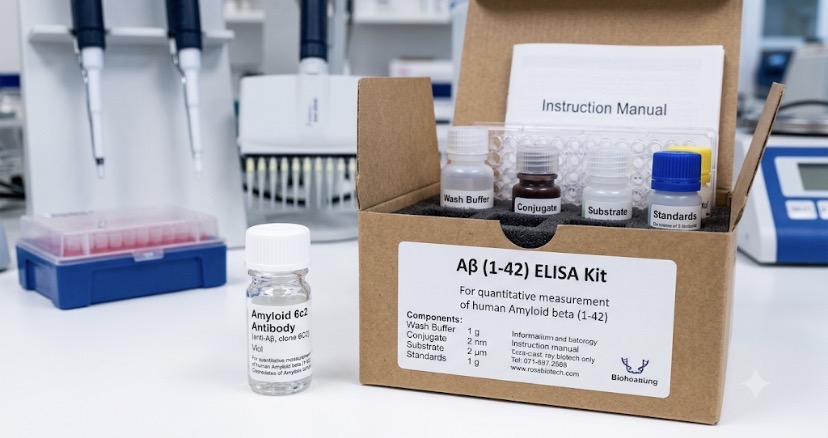
Beta-Amyloid 6C2 Antibody & BA(1-42) Kit | High Purity Peptides
Original price was: 200.00$.170.00$Current price is: 170.00$.
- High Purity Peptides
- Host: Mouse
- Reactivity Species: Human
- Physical State: Liquid
- Temperature Storage: -80°C
- Temperature Shipping: Dry Ice
- Purity: >90% by SDS-PAGE
High Purity Peptides
Beta-amyloid peptide (Abeta), the major constituent of amyloid plaques in the brains of Alzheimer’s patients, is thought to be the cause of Alzheimer’s Disease (AD). AD is the most common neurodegenerative disease and afflicts about 10% of the population over 60. Beta-Amyloid 6C2 (BA-2001) is a rPeptide exclusive Beta-Amyloid Monoclonal Antibody that binds Beta-Amyloid (1-42) and Beta-Amyloid (1-40).
This kit contains Beta Amyloid 6C2 Antibody (1 x 50 μg), Beta Amyloid (1-42) NH4OH (1 x .25 mg)
High Purity Peptides
Molecular properties and chemical space of peptides
[edit]
The chemical space of peptides is defined as a multidimensional landscape shaped by molecular descriptors or fingerprints. Within these frameworks, the distance between specific molecules serves as a proxy for chemical or functional similarity.[28][29] This space can be mapped using primary amino acid sequences, three-dimensional structural data, or a combination of both. Key molecular properties used for mapping include molecular weight, lipophilicity (logP and logD), topological polar surface area (TPSA), and hydrogen-bond dynamics.[29][30] Dimensionality-reduction techniques—such as Principal Component Analysis (PCA), t-SNE, and UMAP—are frequently employed alongside clustering algorithms to visualize peptide libraries and identify clusters with related biological activities.[31][28] Peptides are distinguished from traditional small molecules by their unique combination of residue sequence, amide backbone flexibility, and susceptibility to chemical modifications, all of which dictate bioavailability and membrane permeability.[29] Computational analysis is supported by notation systems like FASTA, HELM, and BILN for encoding both canonical and modified sequences.[27] Modifications such as cyclization or the integration of non-natural amino acids significantly shift a peptide’s position within the chemical space, altering its stability and target affinity. Consequently, chemical-space analysis is a vital tool for virtual screening and the discovery of shared bioactivity regions across different peptide families.
High Purity Peptides
Classification
[edit]
Peptides have been classified according to their sources and functions.[7] Some groups of peptides include plant peptides, bacterial/antibiotic peptides, fungal peptides, invertebrate peptides, amphibian/skin peptides, venom peptides, cancer/anticancer peptides, vaccine peptides, immune/inflammatory peptides, brain peptides, endocrine peptides, ingestive peptides, gastrointestinal peptides, cardiovascular peptides, renal peptides, respiratory peptides, opioid peptides, neurotrophic peptides, and blood–brain peptides.[8]
Some ribosomal peptides are subject to proteolysis. These function, typically in higher organisms, as hormones and signaling molecules. Some microbes produce peptides as antibiotics, such as microcins and bacteriocins.[9]
Peptides frequently have post-translational modifications such as phosphorylation, hydroxylation, sulfonation, palmitoylation, glycosylation, and disulfide formation. In general, peptides are linear, although lariat structures have been observed.[10] More exotic manipulations do occur, such as racemization of L-amino acids to D-amino acids in platypus venom.[11]
Nonribosomal peptides are assembled by enzymes, not the ribosome. A common non-ribosomal peptide is glutathione, a component of the antioxidant defenses of most aerobic organisms.[12] Other nonribosomal peptides are most common in unicellular organisms, plants, and fungi and are synthesized by modular enzyme complexes called nonribosomal peptide synthetases.
High Purity Peptides
These complexes are often laid out in a similar fashion, and they can contain many different modules to perform a diverse set of chemical manipulations on the developing product.[14] These peptides are often cyclic and can have highly complex cyclic structures, although linear nonribosomal peptides are also common. Since the system is closely related to the machinery for building fatty acids and polyketides, hybrid compounds are often found. The presence of oxazoles or thiazoles often indicates that the compound was synthesized in this fashion.[15]
Peptones are derived from animal milk or meat digested by proteolysis.[16] In addition to containing small peptides, the resulting material includes fats, metals, salts, vitamins, and many other biological compounds. Peptones are used in nutrient media for growing bacteria and fungi.[17]
Peptide fragments refer to fragments of proteins that are used to identify or quantify the source protein.[18] Often these are the products of enzymatic degradation performed in the laboratory on a controlled sample, but can also be forensic or paleontological samples that have been degraded by natural effects.[19][20]
Be the first to review “Beta-Amyloid 6C2 Antibody & BA(1-42) Kit | High Purity Peptides”
Related products
All Peptides
All Peptides
All Peptides
All Peptides
All Peptides
All Peptides
All Peptides
All Peptides
Reviews
There are no reviews yet.