

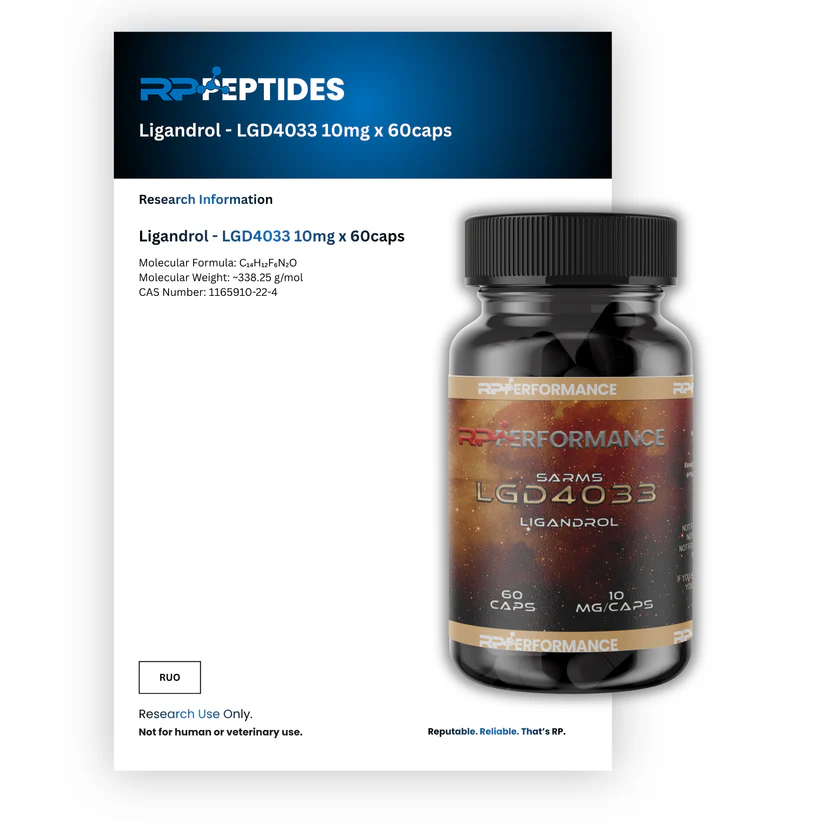
Ligandrol – LGD4033 10mg x 60caps | Research Peptides Sale
25.00$
Product Specifications | Research Peptides For Sale
Compound: LGD‑4033 (Ligandrol)
Form: Capsule
Purity: ≥98%
Packaging: Secure, tamper‑evident container
Use: For use by qualified research professionals only
Disclaimer:
This product is intended strictly for research purposes. It is not for human consumption or use in any therapeutic, diagnostic, or clinical procedures
Research Peptides Sale
RRP Peptides supplies items strictly for laboratory and scientific research purposes only. As part of our commitment to supporting the research community, we ensure all products are manufactured and handled in accordance with high‑quality standards and applicable regulatory requirements. All peptides and products sold by RP Peptides are not intended for human consumption, medical use, or clinical application. If you are seeking high‑quality products for research within the UK, you can explore the RP Peptides catalogue of compounds developed to support scientific study, analytical work, and innovation.
Ligandrol – LGD‑4033 – For Research Use Only
Research Peptides for Sale
LGD‑4033, commonly known as Ligandrol, is a selective research compound offered in high‑purity form for scientific and investigational use only. This compound is not approved for human or veterinary consumption and is intended solely for use in controlled research environments.
Produced under strict quality standards, Ligandrol is supplied to support consistency, reliability, and accuracy in laboratory experimentation.
Research Peptides for Sale
Peptides have been classified according to their sources and functions.[7] Some groups of peptides include plant peptides, bacterial/antibiotic peptides, fungal peptides, invertebrate peptides, amphibian/skin peptides, venom peptides, cancer/anticancer peptides, vaccine peptides, immune/inflammatory peptides, brain peptides, endocrine peptides, ingestive peptides, gastrointestinal peptides, cardiovascular peptides, renal peptides, respiratory peptides, opioid peptides, neurotrophic peptides, and blood–brain peptides.[8]
Some ribosomal peptides are subject to proteolysis. These function, typically in higher organisms, as hormones and signaling molecules. Some microbes produce peptides as antibiotics, such as microcins and bacteriocins.[9]
Research Peptides Sale
Peptides frequently have post-translational modifications such as phosphorylation, hydroxylation, sulfonation, palmitoylation, glycosylation, and disulfide formation. In general, peptides are linear, although lariat structures have been observed.[10] More exotic manipulations do occur, such as racemization of L-amino acids to D-amino acids in platypus venom.[11]
Nonribosomal peptides are assembled by enzymes, not the ribosome. A common non-ribosomal peptide is glutathione, a component of the antioxidant defenses of most aerobic organisms.[12] Other nonribosomal peptides are most common in unicellular organisms, plants, and fungi and are synthesized by modular enzyme complexes called nonribosomal peptide synthetases.[13]
Research Peptides Sale
These complexes are often laid out in a similar fashion, and they can contain many different modules to perform a diverse set of chemical manipulations on the developing product.[14] These peptides are often cyclic and can have highly complex cyclic structures, although linear nonribosomal peptides are also common. Since the system is closely related to the machinery for building fatty acids and polyketides, hybrid compounds are often found. The presence of oxazoles or thiazoles often indicates that the compound was synthesized in this fashion.[15]
Peptones are derived from animal milk or meat digested by proteolysis.[16] In addition to containing small peptides, the resulting material includes fats, metals, salts, vitamins, and many other biological compounds. Peptones are used in nutrient media for growing bacteria and fungi.[17]
Peptide fragments refer to fragments of proteins that are used to identify or quantify the source protein.[18] Often these are the products of enzymatic degradation performed in the laboratory on a controlled sample, but can also be forensic or paleontological samples that have been degraded by natural effects.[19][20]
Peptides can perform interactions with proteins and other macromolecules. They are responsible for numerous important functions in human cells, such as cell signaling, and act as immune modulators.[22] Indeed, studies have reported that 15-40% of all protein–protein interactions in human cells are mediated by peptides.[23] Additionally, it is estimated that at least 10% of the pharmaceutical market is based on peptide products.[22]
Machine learning and deep learning architectures are extensively utilized to classify, screen, and design peptides based on sequence- and structure-derived data.[24][25] These computational approaches are particularly valuable when experimental screening is cost-prohibitive, time-consuming, or difficult to scale. A standard workflow typically involves dataset curation, the transformation of peptide sequences or structures into numerical features, model optimization, and rigorous performance validation.[26] Commonly used representations include amino acid composition, physicochemical descriptors, substitution matrices, and learned embeddings derived from protein or peptide language models.[26][27] These methodologies have been successfully applied across various functional classes, such as antimicrobial peptides, cell-penetrating peptides, and anticancer agents.[25][26] Current challenges in the field include addressing dataset biases, establishing consistent benchmarking protocols, and improving the interpretability of complex “black-box” models.[26][25]
Be the first to review “Ligandrol – LGD4033 10mg x 60caps | Research Peptides Sale”
Related products

All Peptides
Reviews
There are no reviews yet.